AlexNet explained: the 2012 deep convolutional network that launched the deep learning revolution
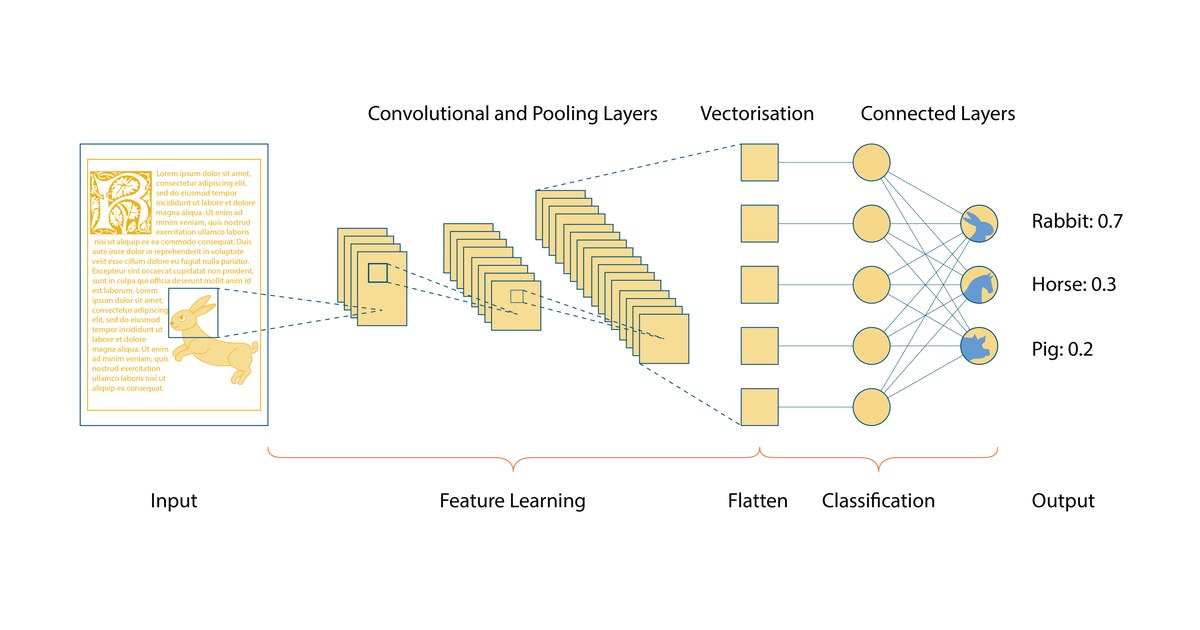
Illustrative image: A convolutional neural network: an input image passes through convolution and pooling layers to a classification output; illustrative of the deep learning approach AlexNet popularised. Image: Irisbox, CC BY 4.0, via Wikimedia Commons.
AlexNet is a landmark deep convolutional neural network (CNN) introduced in 2012 that launched the modern deep learning revolution. Developed by Alex Krizhevsky, Ilya Sutskever, and Geoffrey Hinton at the University of Toronto, the model shattered image recognition benchmarks by winning the ImageNet Large Scale Visual Recognition Challenge on September 30, 2012.
Why It Was a Breakthrough
Before 2012, computer vision relied on manually engineered features combined with traditional machine learning classifiers. AlexNet proved that deep neural networks could automatically learn visual features from massive datasets when paired with modern hardware.
- Massive accuracy leap. AlexNet achieved a top-5 error rate of 15.3% across 1.2 million images and 1,000 object categories. This beat the second-place entry (26.2%) by more than 10.8 percentage points.
- Paradigm shift in AI. Its victory proved that scaling up neural network depth dramatically improves performance. This sparked rapid development across computer vision, natural language processing, and generative AI.
Key Technical Innovations
To train a massive network containing roughly 60 million parameters and 650,000 neurons without overfitting or stalling, the team introduced several techniques that became standard in deep learning:
- Dual-GPU training. The model was too large to fit into the memory of a single consumer graphics card. Krizhevsky split the network across two NVIDIA GPUs, utilizing their parallel processing cores to cut training time down to five or six days.
- ReLU activation functions. Instead of traditional saturating functions like tanh or sigmoid, AlexNet used Rectified Linear Units (ReLU). This prevented vanishing gradients and allowed the network to train several times faster.
- Dropout regularization. During training, the network randomly deactivated 50% of the neurons in its fully connected layers. This forced the model to learn redundant, robust features rather than memorizing training images.
- Data augmentation. The team artificially expanded the training set by applying random image crops, horizontal flips, and RGB color intensity shifts.
- Overlapping pooling. Unlike earlier networks that used non-overlapping pooling windows, AlexNet used overlapping max-pooling layers to preserve better spatial structure and reduce error rates.
Architecture Overview
AlexNet consists of 8 learned layers in total:
- 5 Convolutional layers. These layers use sliding filters (starting with large 11×11 filters) to extract low-level edges and textures, progressing to complex object parts.
- 3 Fully connected layers. These dense layers combine the extracted visual features to classify the image, ending in a 1,000-way softmax output layer that assigns probabilities to each ImageNet category.
The historical source code for the original 2012 model was later preserved and released openly through the Computer History Museum.