Australia and the Philippines sign landmark defence pact as South China Sea tensions rise
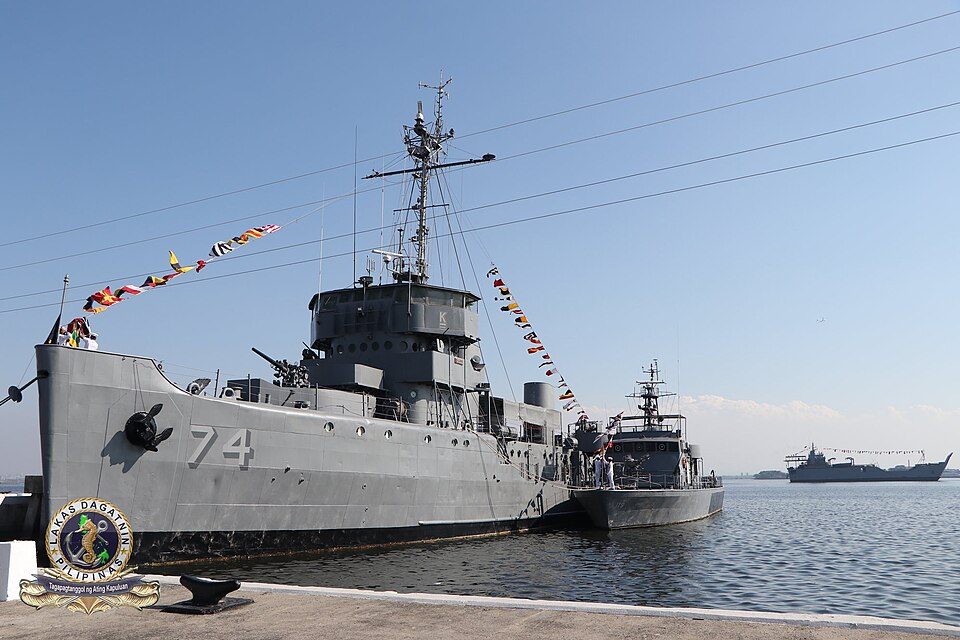
A Philippine Navy ship at port; illustrative file photo, not the signing ceremony. Photo: The Philippine Fleet (PF), Philippine Navy (PN) · Public domain · Wikimedia Commons
Australia and the Philippines have signed a sweeping new defence cooperation agreement, deepening military ties between the two countries at a time of rising tension between Manila and Beijing over control of the strategically vital South China Sea.
The agreement was signed on the sidelines of the ASEAN summit in Manila, where Prime Minister Anthony Albanese met senior Philippines officials. It is expected to expand reciprocal military access and information sharing, and to bolster the capability of the Philippine Navy and coastguard, which have been at the frontline of repeated confrontations with Chinese vessels.
The pact comes as an informal four-nation defence grouping known as 'the Squad' - Australia, the United States, the Philippines and Japan - moves to strengthen the Philippines' defensive capacity and conduct more joint military exercises to counter China's maritime influence in the South and East China Seas. Top defence officials from the four countries met in Cebu last month and revealed the group would establish a Combined Coordination Centre, likely to serve as a joint hub for building the capacity of the Philippine Navy and coastguard.
The South China Sea is one of the world's most important waterways, carrying a significant share of global trade, and its atolls and reefs are rich in marine life. Several South-East Asian nations hold overlapping claims, but China claims almost the entire waterway through its so-called nine-dash line, a claim an international tribunal at The Hague ruled a decade ago has no legal basis under international maritime law. Beijing has rejected that ruling.
China has built artificial islands hosting military bases in the South China Sea, including inside the Philippines' exclusive economic zone and in the heavily contested Spratly Islands. Clashes between the two countries' coast guards occur frequently, particularly around the Spratlys and at Scarborough Shoal off the northern Philippine island of Luzon. Beijing has been accused of 'grey zone' tactics, including water-cannoning and maritime harassment, designed to pressure the Philippines while falling short of triggering open conflict.
Philippines Defence Secretary Gilberto Teodoro has described China's actions as his country's greatest traditional security challenge, calling its behaviour irresponsible, escalatory and provocative, and labelling the nine-dash line the biggest threat to regional stability and peace.
Australia has been steadily ramping up support for Philippine maritime security. Since April last year it has provided more than $13 million to the Philippine Coast Guard, largely in the form of drones and drone-operator training, helping Manila monitor Chinese naval and coastguard vessels, protect subsea cables, watch for illegal fishing and track Chinese military drones. Australia has also helped build defence infrastructure across five Philippine military bases on Luzon.
David Dutton of the Australian Strategic Policy Institute said in a report this week that the Philippines had become pivotal to Canberra's regional balancing and deterrence objectives, describing it as the state under the greatest coercive pressure from China. He called the new agreement a milestone in transforming the relationship into a genuinely strategic partnership.
Maritime security expert Jennifer Parker said the agreement bundles together much of what Australia has already been doing, with a focus on interoperability between the two defence forces, particularly their navies, and the prospect of enhanced information sharing.
The signing comes amid an escalating war of words between Manila and Beijing. Philippines President Ferdinand Marcos Jr recently accused China's ambassador to Manila, Jing Quan, of making a threat after the ambassador said Beijing could 'easily win' in a conflict with the Philippines. The ambassador was summoned by Philippines Foreign Secretary Theresa Lazaro and denied being threatening. China's foreign ministry, for its part, said Foreign Minister Wang Yi had told Ms Lazaro by phone that a handful of Philippine politicians, driven by political bias and selfish gains, had repeatedly attacked and smeared China.
Australia has also drawn rebukes from Beijing. After a confrontation in the Spratly Islands in July, Foreign Minister Penny Wong said Australia was concerned about aggression and destabilising conduct, prompting a Chinese foreign ministry spokesperson to urge the relevant countries to stop exaggerating tensions and inciting confrontation.
South-East Asian leaders are holding high-level talks as part of this year's ASEAN summit, with the South China Sea a key issue. ASEAN nations and China have been negotiating a code of conduct for more than eight years, and Philippine officials say they cannot confirm whether it will be finalised by the end of this summit.
The regional tensions come as analysts observe greater Chinese navy activity in waters near Taiwan. The Institute for the Study of War has analysed what it describes as a rare coordination of China's geographical naval commands, suggesting the People's Liberation Army is conducting a major exercise simulating the isolation of Taiwan, at a time when US naval resources have been drawn towards the Middle East. Ms Parker said the US Navy was under significant pressure and that China appeared to be seeking to take advantage of the reduced American presence in the region.