China Space Station Crew Advances Radiation Exposure Experiments in Orbit
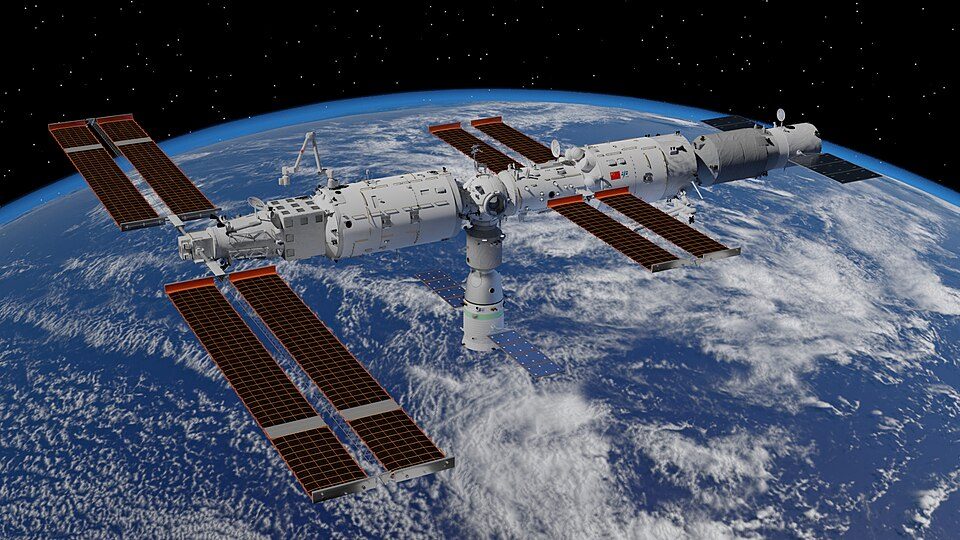
An illustration of the Tiangong space station; not a photo. Photo: Shujianyang · CC BY-SA 4.0 · Wikimedia Commons
BEIJING — China's space station has made steady progress in its fourth round of space radiation exposure experiments over the past week, with samples including nanozymes, actinomycetes and plant seeds brought back inside after completing a five-month exposure outside the station.
The three Shenzhou-23 astronauts — Zhu Yangzhu, Zhang Zhiyuan and Li Jiaying — completed the retrieval, removal and storage of the samples, as well as the handling of the exposure device. Once returned to Earth, the samples will undergo further analysis to help researchers better understand how space radiation affects living organisms, part of China's broader research into the effects of the space environment on biological systems.
The crew also carried out a range of other scientific experiments and routine maintenance. In a study of musculoskeletal responses to microgravity, the astronauts used foot-pressure measurement equipment to collect data during typical workdays, helping researchers examine how forces acting on bones and muscles vary in orbit. They collected nasal and environmental surface swab samples for research into interactions between viruses and immune metabolism, and completed assessments of their emergency decision-making abilities and emotional states, giving ground teams data on how crew responses change over a long mission.
The trio continued routine maintenance of the station's living environment: monitoring cabin air quality through total volatile organic compound and air cleanliness tests, replacing components in the regenerative life-support system and the hot-air heating unit in the space kitchen, and cleaning the cabin. All three kept to their exercise schedules, using equipment designed to counter the effects of weightlessness, including a device to help prevent bone density loss.
China's space station has entered an era of long-term human habitation. The Shenzhou-23 spacecraft was launched on May 24 carrying the three astronauts; two are nearing the end of their sixth month in orbit, while the third is scheduled to remain in space for a full year.