Repeal budget property tax changes now or risk a housing supply crash, Coalition warns
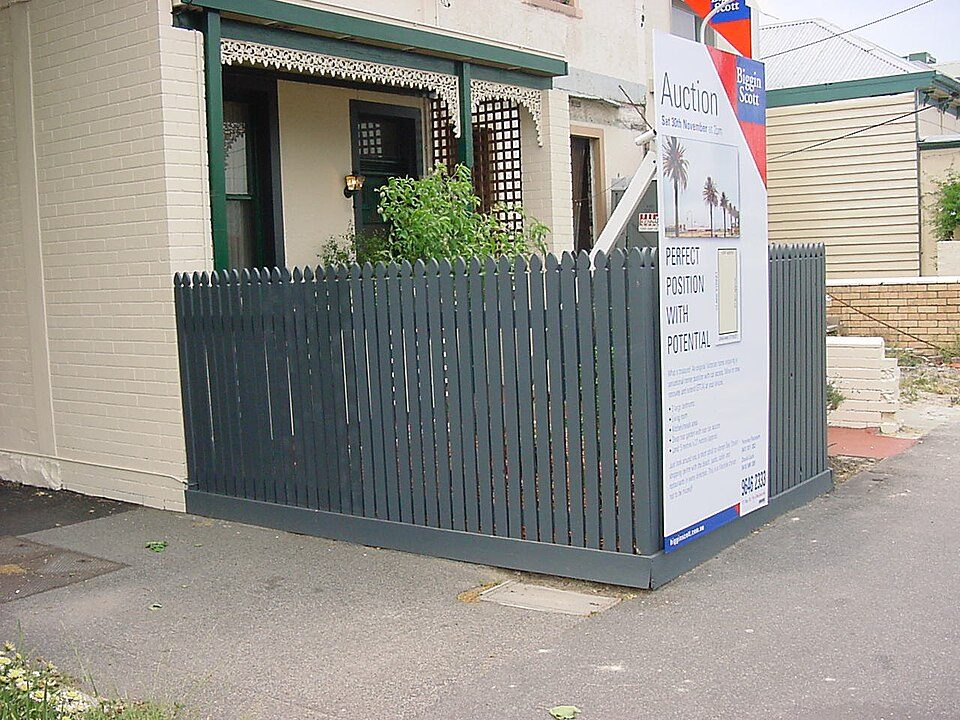
A Melbourne house with an auction board; illustrative file photo. Photo: Tangerineduel · CC BY-SA 4.0 · Wikimedia Commons
Shadow Treasurer Tim Wilson says the outlook for the housing market has become so dire that the government should immediately repeal its property tax reforms, citing plunging auction clearance rates and Reserve Bank predictions of a supply slowdown.
Money flowing into new housing surpassed expectations this year, bolstering Labor's housing agenda. But the Reserve Bank downgraded its outlook last month and now predicts dwelling investment will fall about 2.5 per cent from late next year until 2029, casting doubt on Labor's target of building 1.2 million homes over five years - a target the government is on track to miss.
The central bank used its statement on monetary policy to attribute the drop-off to the ongoing housing market downturn, caused by interest rates rising more than predicted and worsened by the effect of Labor's looming property tax changes. Property analysts, including Cameron Kusher, have described the combination as a perfect storm that would make some new housing developments unprofitable.
Mr Wilson said it was becoming clear that Labor's budget forecast of 35,000 fewer houses as a result of the investor clampdown had underestimated the effect on market sentiment. 'The treasurer needs to do a complete U-turn on the taxes in his federal budget or we will see a continuation of rents rising and housing supply falling,' he said.
The opposition has shifted its messaging from arguing the removal of tax concessions was an attack on aspiration - a message that could fall flat with people locked out of housing - to focusing on the prospect of lower supply and higher rents.
Mr Wilson made the comments as data from property tracker Cotality showed national auction clearance rates had hit 44 per cent, the lowest figure since April 2020, when lockdowns were in place. The number of auctions held in capital cities is more than 40 per cent down on a year ago and has been declining since before the budget.
Labor, meanwhile, welcomed data last week showing loans to investors falling more quickly than loans to first home buyers, after years in which investor tax breaks worsened wealth inequality. Prices in Sydney have already fallen more than 10 per cent from their February peak, making the correction the steepest in decades, with no signs of easing. Government ministers acknowledged the changes to negative gearing, the capital gains tax and trusts were always likely to draw opposition, but said they would benefit voters in the long run if more young people could buy homes.
Mr Wilson countered that housing affordability was getting worse under Labor because interest rate rises were counteracting any benefit from lower prices. The Coalition's promise to repeal the tax changes would punch a hole in its budget forecasts, on top of a $220 billion tax cut that is not fully costed.
Data due later this week on real wages and unemployment will indicate whether the Reserve Bank needs to raise interest rates again. The ongoing war in Iran, an artificial intelligence investment boom, high federal and state spending, and weak domestic productivity have combined to keep prices elevated. Prime Minister Anthony Albanese, in the Philippines for the ASEAN summit, noted that many nations were grappling with high inflation, pointing out that inflation in the Philippines had risen from 2 per cent at the start of the year to 7 per cent.
Employment Minister Amanda Rishworth defended Labor's economic record amid calls to lower spending in the mid-year budget update, saying the government had inherited an inflation number with a six in front of it and that unemployment remained historically low. It has been reported that Labor is examining scaling back tax subsidies for electric vehicle purchases and home batteries.
Focus will turn to Labor's tax agenda in the coming fortnight as the government expects to pass its 30 per cent minimum tax rate on discretionary trusts with the support of the Greens, and will also seek support for its digital duty of care laws and gas reservation rules. The Australian Chamber of Commerce and Industry, the Housing Industry Association, Master Builders and the Property Council have written to senators arguing that discretionary trusts are commonly used by family-owned businesses, which would now find it harder to build. 'As drafted, the bill will increase compliance costs, reduce flexibility and undermine the risk-management approaches many builders rely on,' the letter said.
The government's big-ticket policy to turn around years of underinvestment in affordable housing is also attracting criticism. Treasury's housing chief, Ben Rimmer, questioned in a Senate committee last week by opposition housing spokesman Andrew Bragg, would not explicitly commit to hitting the target of building 30,000 homes by 2029 under the Housing Australia Future Fund. The Reserve Bank's research made clear the weaker market was making life harder for developers, noting that new home sales had declined materially and that many builders reported a fall in enquiries, buyer conversion rates and sales.