Conservatives pledge to halt on-screen exams and cut coursework over AI concerns
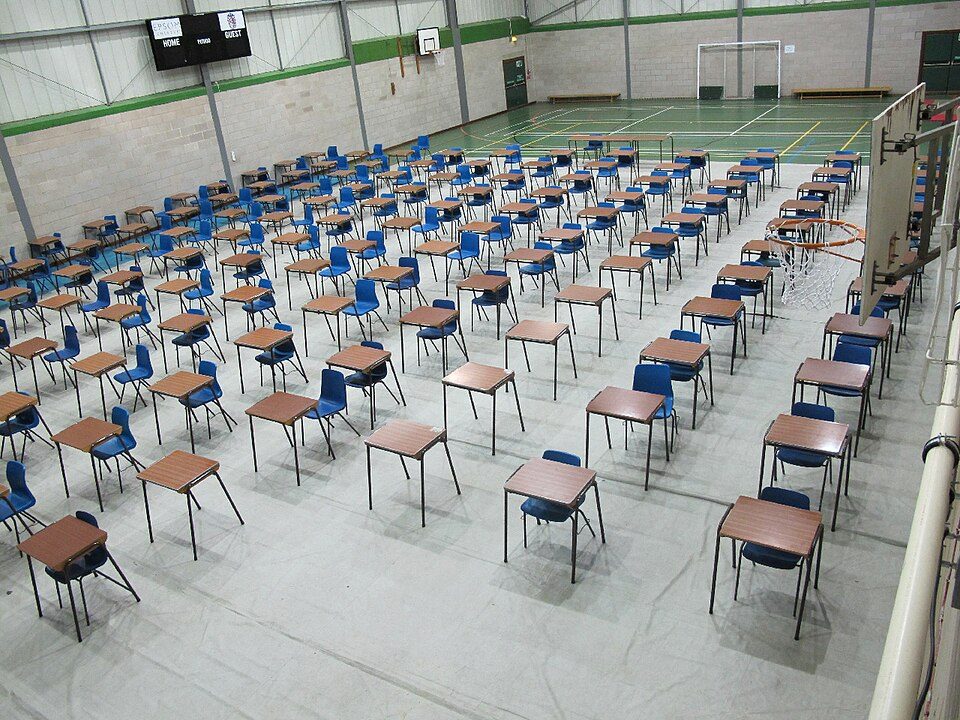
Exam tables in a school sports hall; illustrative, not from the story. Photo: David Hawgood · CC BY-SA 2.0 · Wikimedia Commons
The Conservatives have promised to halt the introduction of screen-based school exams and to cut coursework in a bid to limit children's use of artificial intelligence, if the party returns to power in England.
The party also pledged new guidelines so that laptops and tablets are no longer "the default in classrooms". Shadow education secretary Laura Trott cited recent warnings from clinicians that excessive screen time could be damaging children's health, adding that "everything in schools must be safe for children and improve standards".
The vast majority of school exams in the UK are already pen-and-paper based. Under the previous government, the exams regulator Ofqual consulted last year on introducing on-screen exams, while stressing that pen and paper would "remain central" and that the most widely taken subjects would not move to digital assessment for the foreseeable future.
Under the Conservative plans, the introduction of screen-based exams would be stopped altogether, screen time for secondary pupils would be limited to no more than two hours a day, and primary schools would be required to keep screen use to a minimum, using devices only where necessary, such as in computing lessons. Coursework would be minimised so that standards are not lowered "by allowing children to become overly reliant on the use of generative AI platforms".
The announcement follows an open letter last month from more than 150 clinicians to Education Secretary Lucy Powell and Health Secretary Yvette Cooper, warning that time spent on screens at school could be harming children's "physical and developmental health". The clinicians said they were prescribing glasses, hearing aids and speech therapy "for a problem that is unintentionally being made worse in our schools". Trott said: "I want to slash screen use in classrooms and set a new norm where screens are no longer the default."
Government survey figures from 2024 show 89% of teachers used interactive whiteboards in lessons, but most teachers — 79% in primary and 69% in secondary — said pupils used individual devices in fewer than a quarter of lessons, or not at all. The plans draw on work by the Health Professionals for Safer Screens campaign, whose founder Dr Rebecca Foljambe said daily screen time "can profoundly affect a child's health, whatever they are watching or doing". The party said £900 million currently spent on education technology would be repurposed to create a £250 million fund for new textbooks.
The Department for Education said schools decide their own technology spending, and that it will publish clear guidance on screen use for all children aged 5 to 18 in the new year. A ban on smartphones in English schools has been in force since June, and the UK's social media ban for under-16s comes into force in March. Education is devolved, with each of the four UK nations running its own system.